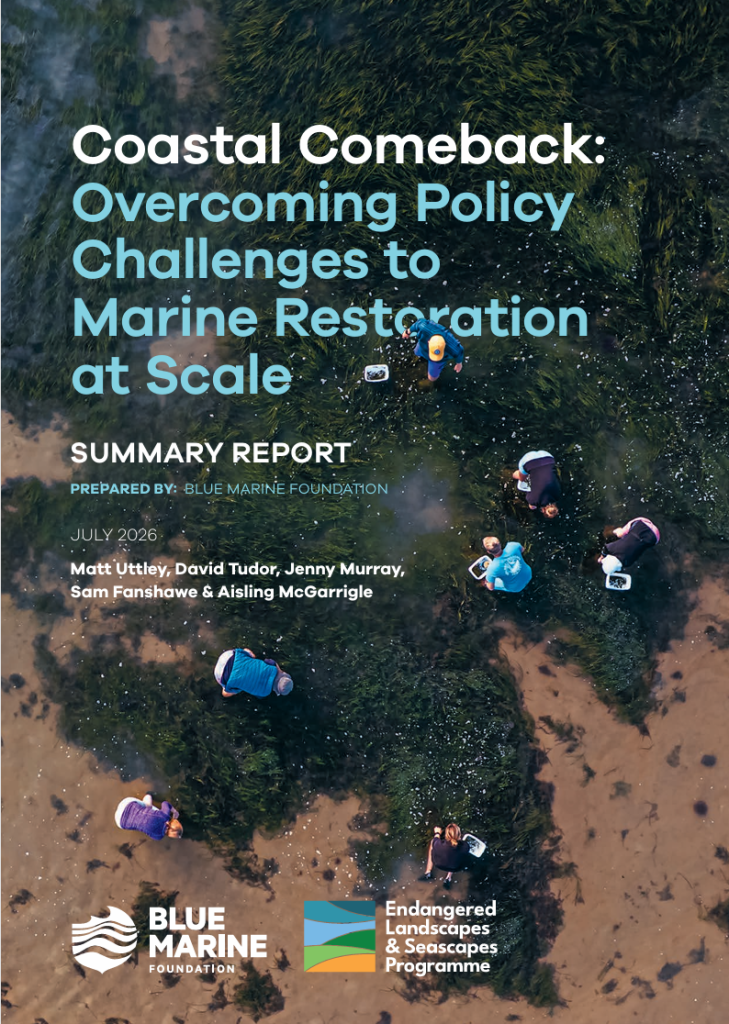
Blue Marine Foundation has published a report – Coastal Comeback: Overcoming Policy Challenges to Marine Restoration at Scale – setting out recommendations and a roadmap to support restoration of key coastal and marine habitats at the scale needed to meet the UK’s biodiversity and climate targets. The evidence set out in the report highlights that the current regulatory system in England and Wales is not designed to effectively enable marine restoration and is the primary barrier to delivery at scale.
Blue Marine is calling for Governments, regulators and practitioners to work together to test and action the recommendations set out in the report and ensure a more proportionate, efficient and enabling approach to marine restoration is achieved.
Urgent restoration needed
Marine habitats have been lost at a staggering rate across the UK. Around 95 per cent of native oyster reefs, 85 per cent of saltmarsh and more than 90 per cent of seagrass meadows have disappeared over the past century due to physical disturbance, pollution, overexploitation, and climate change.
To reverse this decline, active restoration is urgently required, and with increasing scientific understanding, public support, and a rising number of restoration initiatives, momentum is growing. However, most restoration activity remains small-scale and fragmented, with limited progress towards seascape scale recovery.
At present, there is only one defined and established seascape-scale project in the UK -the Solent Seascape Project – and around seven large-scale seascape restoration projects across Europe.
The scarcity of seascape-scale projects in the UK is primarily due to significant policy challenges. The current marine licensing system was designed to manage and reduce environmental impacts from industrial developments, not to enable ecological recovery. As a result, restoration projects are subject to the same complex, time consuming, and costly processes as commercial development. From application to approval the process can take 12 months or more, involving multiple permissions administered by various government agencies and landowners and costing tens of thousands of pounds before a single oyster is laid or seagrass seedling planted.
Key policy barriers
Through evidence and case studies drawn from across the UK and internationally, supported by extensive stakeholder engagement with regulators, governments, practitioners, and researchers, Blue Marine has identified the key policy and delivery challenges to marine restoration at scale and proposes a suite of actions and policy reform to overcome them.
Proposed solutions range from reducing financial costs of licencing and improved guidance for regulators and practitioners to navigate the complex consenting process, to proposals for legislative change supported by a legal review undertaken by The Lifescape Project.
Blue Marine is calling for the establishment of a dedicated and coordinated licensing pathway for marine restoration that is distinct from industrial development, with assessment, evidence and fees proportionate to ecological risk and project scale. This should include a single-entry application process, clearer cross-regulator guidance and decision making that recognises restoration as a beneficial activity by weighing long term environmental gain against the cost of inaction. Moreover, targeted legal and policy reform should remove key barriers such as misclassification of restoration materials as waste, overly rigid feature-based assessments and the lack of a statutory duty on regulators to support the recovery of marine ecosystem.
Together, these provide a practical route to a more proportionate and enabling regulatory framework – one that recognises restoration as a distinct, nature positive activity central to delivering national and global biodiversity commitments.
The reform agenda set out in the report is grounded in existing legal mechanisms, with many actions deliverable using powers already held by governments and their agencies. Blue Marine intends to explore each of the proposed reforms collaboratively with government, regulators and the organisations actively involved in marine and coastal restoration and to test how the proposals can be applied in practice.
The key challenges and solutions are set out in Coastal Comeback; Overcoming Policy Challenges to Marine Restoration at Scale, a Summary report launched by Blue Marine at the ReMeMaRe Conference in Scarborough on 8 July. A full technical supporting document includes case studies, the current regulatory framework and the legal review undertaken by The Lifescape Project.